Astrophysics
Exploring the isotopic 'landscape' helps physicists build models of nuclear interactions. Precision mass measurements from TITAN will improve our understanding of the astrophysical reaction paths that create all visible matter.
Fundamental Symmetry Studies
Combining TITAN data with other results from ISAC will allow physicists to test predictions made by the standard model. Compelling evidence for new physics will be confirmed if new measurements agree with existing data.
The TITAN Experimental Program
Measuring the mass of short-lived isotopes with high precision
Radioactive isotopes from ISAC are sent to TITAN to undergo cooling, charge-breeding and trapping. The entire process occurs in about 10 milliseconds, allowing radioactive isotopes with short half lives to be studied.
Nuclear isomers
Just as we study an atom's electron structure to understand chemical reactions, the nuclear structure can be probed to gain a better understanding of nuclear reactions. TITAN will be used to look at a class of isotopes that can change states to reduce their internal energy.
Laser & X-ray Spectroscopy
Nuclear models can be checked against their predictions for the nuclear charge radius, and spectroscopy is one way to perform this check. TITAN will study isotopes previously inaccessible to other experiments, and use highly charged ions for increased sensitivity.

TITAN News
April 2014: Neutrinoless double beta decay, an extremely rare decay if it exists, would violate the Standard model and help characterize the neutrino's nature. At TITAN, the Q-value of Ca-48 has been directly measured, and its nuclear matrix element has been calculated using diagrammatic many-body perturbation theory to the second order. The increase in both quantities strengthen the case for a Ca-48 double-beta-decay experiment.
[
LINK].
Year 2014: IOP Physics Scripta publication highlights 2013: Two TITAN publications featured.
You can now view the Highlights collection and booklet online
[
LINK].
November 2012: Nobel laureate Dave Wineland visiting Jens Dilling and the TITAN experiment
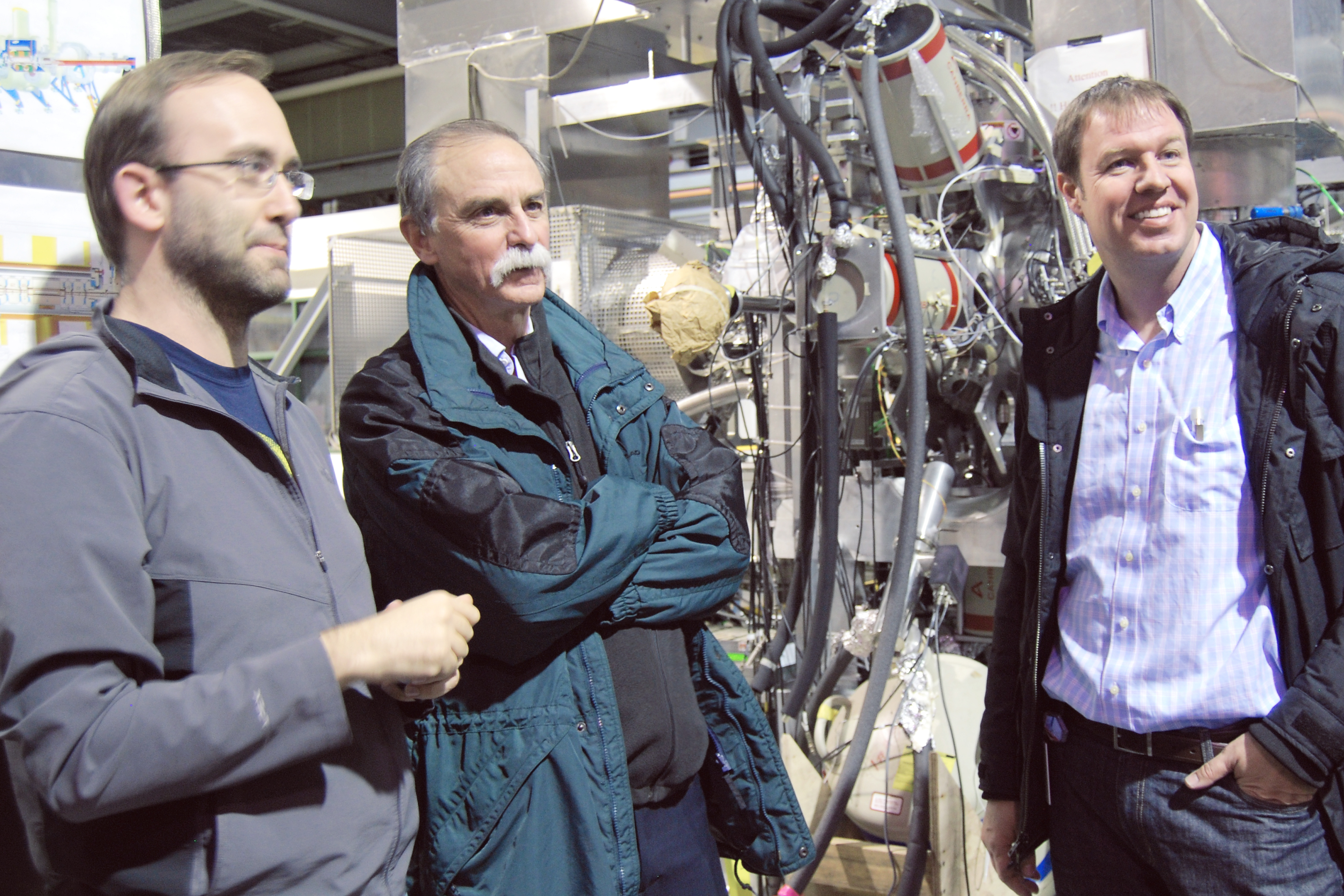 |
Brad Schulz on the left, explains the Cooler Penning Trap system (21 November 2012).
May 2012: Anomaly explained
Recent high-precision mass measurements of 9Li and 9Be, performed with the TITAN Penning trap at the TRIUMF ISAC facility, are analyzed in light of state-of-the-art shell model calculations. We find an explanation for the anomalous isobaric mass multiplet equation behaviour for the two A=9 quartets.
January 2012: First direct mass-measurement of the two-neutron halo nucleus 6He and improved mass for the four-neutron halo 8He
The first direct mass-measurement of 6He and a mass-measurement of 8He at improved precision has been performed at TITAN. The 6He value shows a deviation from the literature of 4 sigma. We present a detailed comparison to nuclear theory for 6He, including new hyperspherical harmonics results. A correlation plot of the point-proton radius (calculated using the new masses) with the two-neutron separation energy demonstrates clearly the importance of three-nucleon forces.
Year 2012: Performance of TITAN Penning trap in sub-ppb level!
The TITAN Penning trap has been built and optimized in order to perform high precision mass measurements with an accuracy in the sub ppb-range on both singly and highly charged ion. A detailed characterization of the TITAN Penning trap is presented and a new compensation method is derived and demonstrated, verifying the performance in the range of sub-ppb.
Year 2011: Hello halos!
The TITAN Penning trap measured the masses of several neutron halos. Combined with laser spectroscopy measurements of isotopic shifts, precise masses can be used to obtain reliable charge radii and two-neutron-separation energies for these halo nuclei. It is shown that these results can be used as stringent tests of nuclear models and potentials providing an important metric for our understanding of the interactions in all nuclei.
Year 2011: Short Lived, but Highly Charged.
The results of TITAN's first mass measurements of highly charged, short-lived nuclides in a Penning trap have been published in Physical Review Letters ([
DOI). The studies have been performed in charge states q=8-12+ and include the nuclide 74Rb with a half-life of only 65 ms. You can have a look at
[
TRIUMF news] link.
May 10: TITAN collaboration meeting.
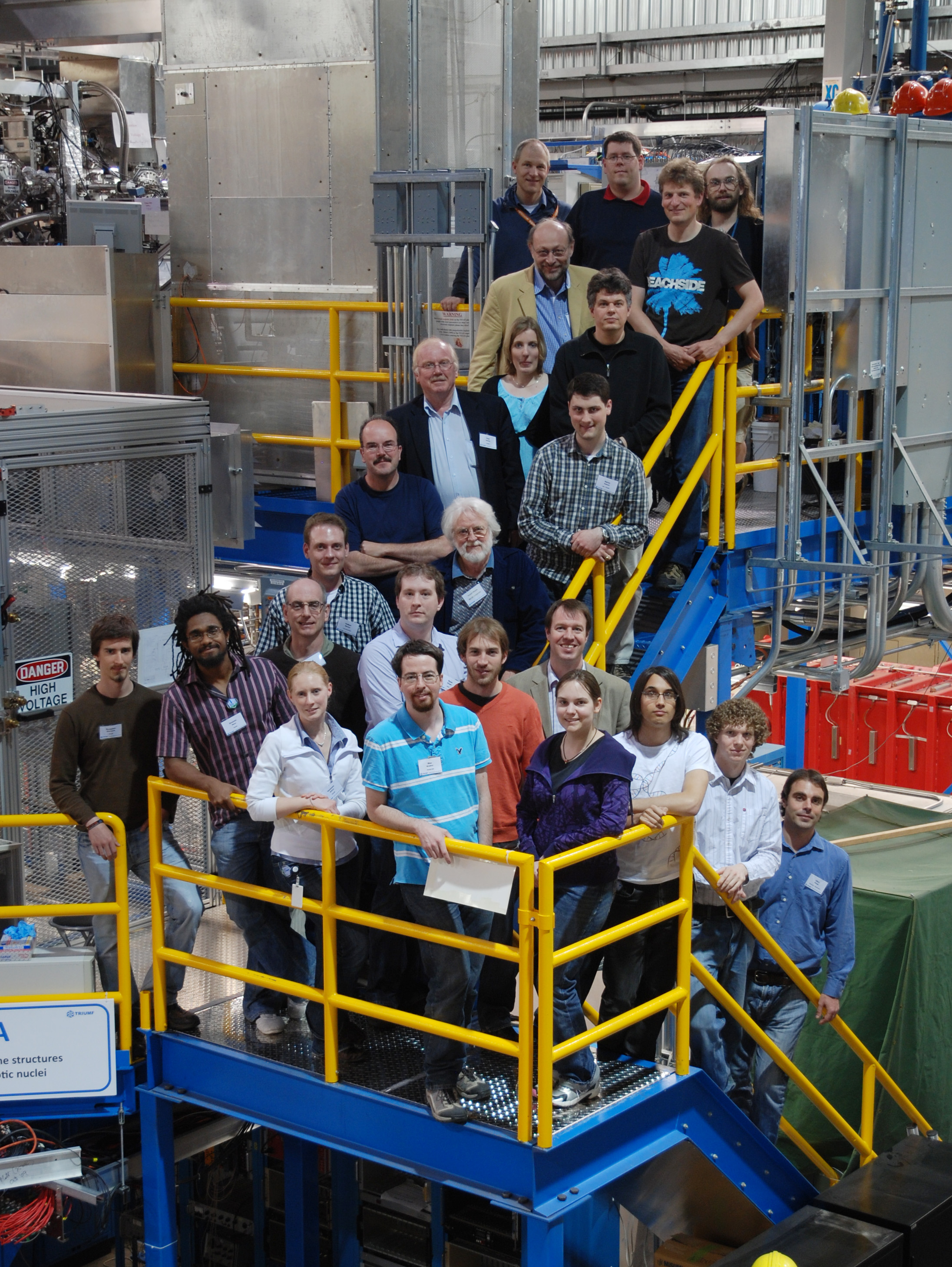
From May 24 to May 26 a TITAN collaboration meeting took place at TRIUMF. During this meeting the current status of TITAN was presented and road maps for TITAN's different experimental devices were defined. Please follow this
link to view the group picture.
Oct 09: New mass measurement of 6Li published in PRC.
The frequency ratio of
6Li to
7Li was measured using the TITAN Penning trap mass spectrometer. This measurement resolves a 16-ppb discrepancy between the
6Li mass of 6.015 122 795(16) u from the Atomic Mass Evaluation 2003 (AME03) [
DOI].
July 09: Systematic studies for future EC-BR measurements.
Towards the determination of 2nbb matrix elements, we performed systematic studies with 124Cs and 126Cs. First, the radioactive ions were identified by their half life. Afterwards, we stored them inside the Penning trap and observed X-rays following an electron capture. A first summary of the run can be found
here.
May 09: The 8, 9, 11Be high-precision mass measurement are published in PLB.
The results of the High-precision Penning trap mass measurements of 9,10Be and the one-neutron halo nuclide 11Be are published in
Phys. Lett. B 675, 170 (2009)
Nov 08: The 11Li mass measurement paper is published in PRL.
The results of the First Penning-Trap Mass Measurement of the Exotic Halo Nucleus 11Li are published in
Phys. Rev. Lett. 101, 202501 (2008)
Nov 08: First resonance in a highly charged ion (He-like Oxygen) with the Penning-trap mass spectrometer.
Nov 08: First test run for future electron-capture branching ratio (ECBR) measurements in singly charged ions.
In-107 ions were injected and trapped into the EBIT -used in the Penning trap mode- and we observed X-ray / Gamma lines and Beta electrons from In-107 ions.
Oct 08: Highly charged ions are extracted from the EBIT
For the very first time, highly charged nitrogen and oxygen ions are extracted from the EBIT and sent to the switch yard and the Penning trap.
Sept 08: First ions into EBIT
The EBIT is now completely connected to the TITAN beam line and first ions were shot through the trap and detected on a MCP at the gun position.
Aug 08: TITAN-EBIT revival
The TITAN-EBIT is revived after two years of
inactivity. A new electron collector was installed, trap electrodes were
cleaned from spark-burned cryogenic vacuum grease, and an EPICS-controlled
(PLC) vacuum system was installed. The electron gun cathode is being
conditioned and producing a 20-mA electron beam.
Aug 08: TITAN cooler trap meeting
A meeting with collaborators from the University of Manitoba was held to coordinate the design and construction of the new TITAN cooler trap.
Jul 08: TITAN's 8He mass measurement published in Physical Review Letters
The result of the first Direct Mass Measurement of the Four-Neutron Halo Nuclide 8He is published in Phys. Rev. Lett. 101, 012501 (2008).
Dec 07: Second Li run
- 8Li and 9Li measured with an uncertainty of ~200eV.
- First Penning trap mass measurements of 8Li and 9Li.
- Mass measurement of shortest lived isotope ever trapped: 11Li with an uncertainty of ~1keV.
- 1200 ions/sec from ISAC and a RFQ repetition rate of 50Hz.
Nov 07: First Penning trap mass measurements of 8He at TITAN
- First direct mass measurement of 8He with an uncertainty of ~400eV.
- H2 used in RFQ as buffer gas.
- Yield of ~3100 ions/sec from ISAC.
Aug 07: First on-line mass measurements at TITAN
TITAN's 1st Experiment Takes Precision Mass of On-line Lithium Ions (more).
July 07:
- 6Li source installed on the beamline in front of the RFQ.
- First tests with the MPET (axial excitation).
- Installation of the new EBIT collector. The coil of the first one was shorted.
June 07: Commissioning of the MPET
Commissioning of the MPET beamline vacuum system. The MPET vacuum chamber
is connected to the rest of the ISAC beamline.
April 07: MPET alignment
- Determination of the longitudinal magnetic field axis (Bz) using a hall
probe.
- Alignment of the MPET vacuum chamber with respect to Bz using an
electron gun.
March 07: OLIS beam time
Emittance measurements of the RFQ with the OLIS source and reversed extraction carried out.
Dec 06: First reverse extraction
The first reversed extraction from the RFQ was demonstrated using our offline test source.
Aug 06: Precision Penning trap magnet arrives
The magnet will be charged shortly and tested for field homogeneity.
April 06: EBIT arrives
The EBIT arrived safely from MPI in Heidelberg. Work continues on the TITAN platform, which recieved electrical power recently.
TITAN cooler trap development has started
G. Gwinner at the University of Manitoba has received the grant to develop the HCI cooling trap. The trap will be used at TITAN to increase the setup efficiency when working with highly charged short-lived isotopes.
First tests of TITAN EBIT are successful!
TITAN EBIT transmits electron beam of up to 50mA in the first tests.
TITAN collaboration meeting TRIUMF, Vancouver, June 10-11, 2005
TITAN collaboration meeting and workshop materials can be found here.